
Starting a Business in Pune: Tax, GST & Accounting Requirements
A practical guide to the key tax, GST, accounting and compliance requirements to consider when starting a new business in Pune and Maharashtra.
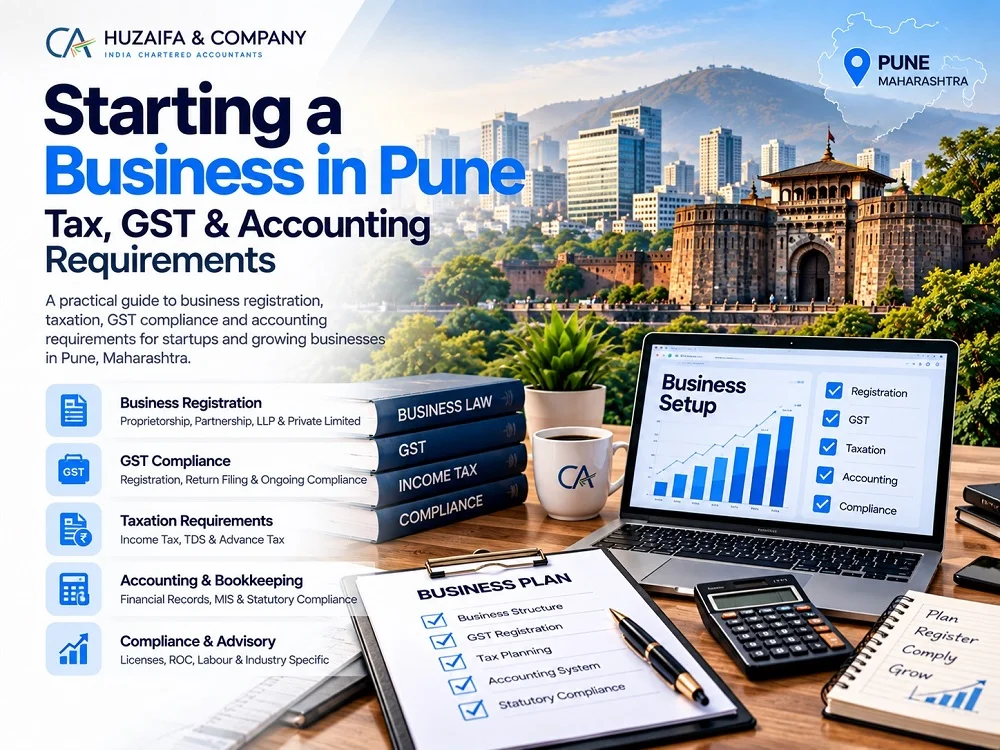
Starting a business in Pune involves more than choosing a business name and beginning operations. The business structure, registrations, GST position, accounting system and tax responsibilities should be considered together so that the financial foundation is organised from the beginning.
Whether you are launching a professional practice, trading business, service company, manufacturing activity or startup, the exact requirements depend on the nature and structure of the business. This guide provides a practical starting point for understanding the areas that should be reviewed.
Review your business structure, registrations, GST applicability, invoicing, bookkeeping, income-tax responsibilities, TDS/payroll requirements and recurring compliance before and after starting operations.
Choose the Right Business Structure
One of the first decisions is choosing a structure that fits the ownership, liability, operating model and future plans of the business. Common forms include sole proprietorships, partnership firms, LLPs, One Person Companies and private limited companies.
The appropriate structure can affect taxation, compliance, ownership, funding and how the business is managed. It is therefore useful to consider the expected scale and requirements before registration rather than choosing a structure only because it appears simple at the start.
Common structures to consider
- Sole Proprietorship: Individual-owned businesses with a relatively simple operating structure.
- Partnership Firm: A structure for two or more partners operating under a partnership arrangement.
- LLP: A separate legal structure combining partnership-style management with limited liability features.
- One Person Company: A corporate option for an eligible single-member business.
- Private Limited Company: A corporate structure often considered where formal shareholding, growth or investment requirements are relevant.
Select the structure after considering ownership, liability, taxation, compliance, funding and long-term business plans.
Complete the Applicable Business Registrations
After selecting the structure, identify the registrations and permissions that apply to the business. The list can vary depending on the business activity, entity type, premises, employees and applicable state or local rules.
Registration areas to review
- PAN and basic identity or constitution documents.
- Business or entity registration documents, where applicable.
- Proof and documentation relating to the principal place of business.
- GST registration, where applicable.
- Udyam/MSME registration, where relevant to the business.
- Sector-specific licences or permissions where applicable.
- Local registrations or establishment-related requirements applicable to the premises and activity.
For GST registration, CBIC rules require applicants to provide specified information and documentation through the GST registration process. The official GST Portal also provides a document checklist for registration.
Understand GST Registration Requirements
GST is one of the most important compliance areas for a new business. GST registration depends on the nature of supplies, turnover and other conditions under the applicable GST law. Certain situations can also trigger registration requirements independently of a general turnover test.
Businesses in Pune should therefore review their actual activities, customers, supply locations and transaction model before deciding whether GST registration is required.
GST thresholds and compulsory-registration provisions can depend on the applicable law, notifications and facts of the business. Avoid relying on an old threshold without checking the current position.
GST registration preparation
- Confirm the legal name and PAN of the business.
- Identify the principal place of business.
- Keep constitution and address documents ready.
- Identify authorised signatory details.
- Review the nature and location of taxable supplies.
- Check whether any compulsory-registration condition applies.
Set Up Proper Invoicing From Day One
Your invoicing system should be established before significant sales begin. Proper invoices make accounting, GST reporting, customer collections and reconciliation easier to manage.
Invoice checklist
- Correct business name and address.
- PAN and GSTIN where applicable.
- Unique invoice number and invoice date.
- Customer details and GSTIN where applicable.
- Description and classification of goods or services.
- Taxable value and applicable taxes.
- Place-of-supply treatment where applicable.
- Payment terms and bank details where appropriate.
Set Up Accounting From the Beginning
Accounting should not be postponed until the first tax return is due. A new business should establish a consistent system for recording revenue, purchases, expenses, receivables, payables and bank transactions from the start of operations.
Keep business and personal transactions organised
Use appropriate business banking and accounting records so that personal transactions are not mixed with business income and expenses. Keep invoices, receipts, contracts, payment records and other supporting documents organised.
Understand Income-Tax Responsibilities
Income-tax compliance depends on the legal structure and circumstances of the business. Proprietors, firms, LLPs and companies can have different return and tax requirements.
The Income Tax Department publishes structure-specific guidance and return forms. For example, for AY 2026–27, business or professional income can fall under applicable return categories such as ITR-3 or ITR-4 depending on the taxpayer and the relevant conditions.
Review these areas
- Applicable income-tax return.
- Advance-tax requirements where applicable.
- Presumptive taxation eligibility where relevant.
- Business expense and supporting-record requirements.
- Tax deduction and collection responsibilities where applicable.
Review TDS, Payroll & Employee Compliance
Hiring employees or making certain payments can introduce additional tax and statutory responsibilities. TDS requirements depend on the nature of payments and the applicable provisions.
If the business plans to employ staff, establish payroll records and review the applicable employee-related registrations, deductions and filings before the workforce expands.
Review whether TDS or payroll-related compliance applies before making recurring payments rather than trying to reconstruct the records later.
Create a Business Compliance Calendar
A compliance calendar helps a new business track recurring obligations instead of depending on memory or last-minute filing. The exact dates and obligations depend on the registrations and structure of the business.
Check Whether DPIIT Startup Recognition Applies
If the new Pune business is a startup, it may be useful to check whether it meets the current criteria for DPIIT startup recognition. Startup India states that eligible entities can include Private Limited Companies, registered Partnership Firms, LLPs and certain other qualifying entities, subject to the applicable criteria.
As of the 2026 update, Startup India states that the turnover threshold for normal startup recognition has been revised to ₹200 crore, with a separate ₹300 crore threshold for DeepTech startups, alongside other eligibility requirements. Recognition and any tax exemption are separate steps and should not be treated as automatic benefits.
Check the current DPIIT recognition criteria before applying because the eligibility rules and notified requirements can change.
Consider Pune & Maharashtra-Specific Requirements
A business operating from Pune should also identify state and local requirements relevant to its activity and premises. The requirements for a software company, professional practice, retail outlet, manufacturing unit or food business may be different.
Review the business location and activity
- Principal place of business and address documentation.
- Applicable Maharashtra registrations or establishment requirements.
- Local permissions relevant to the premises and activity.
- Sector-specific licences, if applicable.
- Employee-related requirements where applicable.
Do not assume that one registration covers every requirement. Map the actual business activity first and then identify the applicable approvals.
Starting a Business in Pune: Practical Checklist
Before and immediately after starting operations, review the following areas according to your business structure and activity.
Choose a structure that fits ownership, liability and future plans.
Complete the registrations and licences that actually apply to the business.
Check registration applicability and establish compliant invoicing processes.
Start bookkeeping and document management from the first transactions.
Understand income-tax, TDS and other applicable tax responsibilities.
Track recurring filings, payments, reconciliations and statutory records.
Common Mistakes New Businesses Should Avoid
Many compliance problems begin with weak processes rather than complicated transactions. Establishing basic financial controls early can reduce avoidable errors as the business grows.
Selecting a structure without considering future funding, ownership or compliance needs.
Using business records for personal transactions can make accounting and tax review difficult.
Waiting until year-end can create missing records and reconciliation problems.
GST registration should be reviewed based on the actual business model and applicable rules.
Without a calendar, filing and payment obligations can be overlooked.
Choose the business structure based on actual ownership and long-term requirements.
Identify the registrations and licences applicable to your activity and location.
Review GST applicability before starting taxable operations.
Set up accounting, invoicing and document management from day one.
Understand income-tax, TDS and payroll responsibilities where applicable.
Use a compliance calendar to track recurring financial and statutory requirements.
Conclusion: Start With a Structured Financial Foundation
Starting a business in Pune is not only about incorporation or opening for customers. The early decisions around business structure, GST, accounting, taxation and compliance can shape how easily the business manages its finances as it grows.
A practical approach is to identify the requirements before operations begin, establish accounting and invoicing processes from the start, and maintain a regular review of tax and compliance obligations.
The exact requirements vary by business structure, activity, turnover, transaction type and applicable law. For specific circumstances, the current rules and registrations should be reviewed before making compliance decisions.
Starting a business in Pune?
Discuss your accounting, taxation, GST or business compliance requirements with CA Huzaifa Momin.
DISCUSS YOUR REQUIREMENTSources & Further Reading
This article uses official Government of India and Maharashtra resources for the general compliance points discussed. Rules, thresholds and procedures can change through legislation, notifications and administrative updates.
- GST Portal — Government of India
- CBIC — GST Registration Rules
- GST Portal — GST Registration Document Checklist
- Income Tax Department — Business / Profession Income
- Startup India — DPIIT Startup Recognition
- Startup India — Maharashtra State Startup Policy
- Ministry of Corporate Affairs — MCA