
Starting a Business in Pune: Tax, GST & Accounting Requirements
A practical guide to the accounting systems, financial records, tax processes and compliance routines founders should establish from day one.
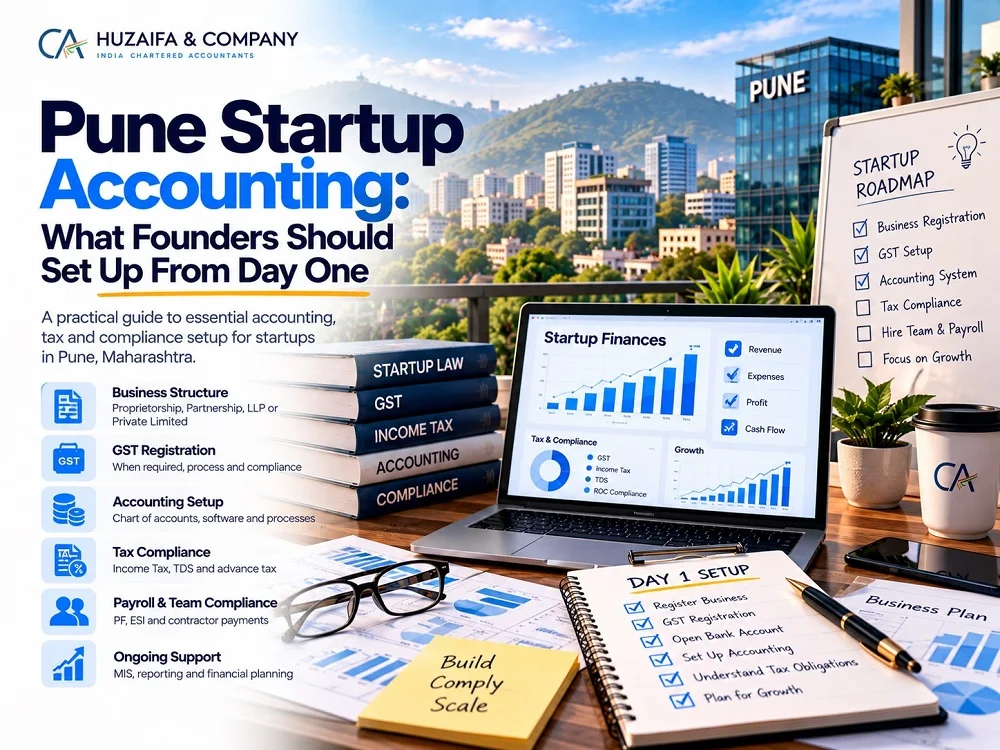
Startup accounting should begin when the business begins, not when the first tax return or funding round arrives. A founder needs a reliable way to record revenue, expenses, founder funding, customer payments, vendor bills, taxes and cash movements from the first day of operations.
For startups in Pune, putting these systems in place early can make monthly reporting, GST and TDS processes, tax preparation, fundraising discussions and financial decision-making easier to manage as the business grows.
Separate business finances, choose an accounting system, record founder funds, set up invoicing, track GST and TDS, reconcile the bank, monitor cash flow, preserve documents and establish a monthly financial close process.
Separate Business and Personal Finances From Day One
One of the first accounting controls a founder should establish is a clear separation between business and personal transactions. Business receipts, operating expenses, founder contributions and business payments should be identifiable in the accounting records.
Set up the basics
- Use an appropriate business bank account for business collections and payments.
- Keep business expenses supported by invoices, receipts or other records.
- Record founder contributions separately from business revenue.
- Record money withdrawn by founders using the appropriate accounting treatment.
- Avoid using the business account as a general personal spending account.
Clean separation makes reconciliation, reporting and tax preparation easier to review.
Choose an Accounting System and Chart of Accounts
A startup should decide early how its financial transactions will be recorded. The system can be software-based, accountant-managed or a combination of both, but the underlying records should remain consistent and reviewable.
Define the records you will track
- Sales and other operating income.
- Direct and operating expenses.
- Accounts receivable and customer advances where applicable.
- Vendor payables and other liabilities.
- Bank balances, fixed assets and other business assets.
- Founder capital, loans and other funding sources.
Record Founder Capital, Loans and Startup Expenses Correctly
Early-stage businesses often receive money from founders before meaningful customer revenue begins. Those funds should be recorded according to their actual nature rather than being treated automatically as sales income.
Keep funding trails clear
- Document founder capital introduced into the business.
- Keep separate records for founder or related-party loans where applicable.
- Preserve bank statements showing transfers into the business.
- Keep invoices and receipts for incorporation and operating expenses.
- Maintain agreements or supporting documents for material loans and funding arrangements.
Founder funding, loans, customer receipts and other inflows can have different accounting and tax treatment.
Set Up Invoicing and Revenue Tracking Before Sales Scale
A startup should be able to answer a simple question at any time: what was sold, to whom, for how much, when was it invoiced and whether the customer has paid. A consistent invoicing process connects sales activity with accounting.
Invoice and revenue checklist
- Use a consistent invoice numbering system.
- Capture customer identity and GST details where applicable.
- Record invoice date, description, value and applicable taxes.
- Track credit notes, debit notes and cancellations where applicable.
- Track payment status and outstanding receivables.
- Reconcile invoiced revenue with accounting records and bank collections.
Build GST Accounting and Reconciliation Into the Monthly Process
If the startup is registered under GST or otherwise has GST obligations, the accounting system should capture the information needed for GST reporting. Sales, purchases, input tax credit and tax liabilities should be reviewed against the underlying books and documents.
Monthly GST accounting checks
- Reconcile sales invoices with outward-supply reporting.
- Review purchase invoices and relevant GST data before claiming eligible ITC.
- Track output tax liability and applicable reverse-charge transactions.
- Review e-invoice and e-way bill applicability where relevant.
- Keep GST returns, payment records and reconciliation workings organised.
GST registration and reporting requirements depend on the business model and applicable law. Founders should verify the current rules rather than relying on an old turnover threshold or historical compliance practice.
Set Up TDS, Payroll and Employee Records Early
Once a startup begins paying employees, professionals, contractors, landlords or other vendors, the accounting process may need to capture TDS and payroll obligations. These should be integrated with the monthly bookkeeping process.
Records to maintain
- Employee salary and payroll records.
- Vendor and professional payment records.
- TDS calculations and supporting documents where applicable.
- TDS payment and return records where applicable.
- Employee-related statutory records relevant to the startup.
For TDS events from 1 April 2026, the Income Tax Department states that the Income Tax Act, 2025 applies; the earlier Act applies to relevant events up to 31 March 2026.
Perform a Monthly Bank Reconciliation and Financial Close
Bank reconciliation should be a recurring monthly task. The goal is to compare the accounting records with bank transactions and identify missing entries, duplicated entries, uncleared items or transactions that need classification.
Obtain the complete statement for the period.
Compare recorded receipts and payments with the statement.
Identify unmatched, duplicate or incorrectly classified transactions.
Complete adjustments and lock the monthly reporting period.
Track Receivables, Payables and Cash Flow
A startup can report revenue and still face cash pressure if customer collections are slow or vendor commitments are not tracked. Founders should therefore review cash movement alongside the profit and loss account.
Founder dashboard
- Cash and bank balances.
- Customer receivables and ageing.
- Vendor payables and upcoming commitments.
- Monthly operating expenses.
- Expected customer collections.
- Upcoming tax, payroll and statutory payments.
Maintain Books and Supporting Documents in an Organised System
Good accounting is not only about numbers. The underlying invoices, contracts, bank records and payment evidence help explain the entries recorded in the books. Keep a consistent digital filing structure and make sure important records can be retrieved when required.
Core startup records
- Sales invoices and customer contracts.
- Purchase invoices and expense receipts.
- Bank statements and reconciliation workings.
- GST, TDS and tax payment records where applicable.
- Payroll and employee-related records.
- Founder funding, loan and investment documents.
- Important legal, incorporation and statutory documents.
Prepare Early for Tax Returns and Financial Statements
Year-end compliance becomes easier when monthly books are already reconciled. Founders should understand which financial statements and tax return requirements apply to their entity and keep the records needed to support them.
- Keep revenue and expense ledgers updated.
- Reconcile bank, receivables and payables.
- Maintain fixed-asset and depreciation-related records where applicable.
- Review tax payments, TDS and GST records.
- Maintain supporting documents for significant transactions.
- Coordinate with the CA before year-end rather than after the year closes.
The return and accounting requirements depend on the entity and circumstances. The Income Tax Department publishes taxpayer-specific guidance and return forms.
Build Accounting That Can Support Funding and Investor Reporting
If the startup plans to raise external funding, financial records should be capable of explaining revenue, expenses, cash use, liabilities, founder holdings and material commitments. Investors and advisors may also require historical financial statements, bank records and transaction documentation.
Keep funding information organised
- Maintain a clear record of founder and investor contributions.
- Keep term sheets, investment agreements and funding documents together.
- Track ownership and share-related records through the appropriate corporate process.
- Maintain reliable monthly revenue and expense reporting.
- Separate operating performance from one-time funding inflows.
DPIIT recognition and tax benefits such as the applicable startup profit deduction have separate eligibility and application conditions. Do not assume that recognition automatically means every tax benefit applies.
Create a Pune and Maharashtra Compliance Calendar
A startup should maintain one calendar covering tax, GST, TDS, payroll, corporate filings and other recurring obligations relevant to its structure and activity. The exact dates and obligations vary, so the calendar should be maintained against current official requirements.
Pune Startup Accounting: Practical Day-One Checklist
Founders do not need a complicated finance department on the first day. They do need a repeatable system that records transactions correctly and makes important information easy to retrieve.
- Choose the legal structure and understand its accounting requirements.
- Open and use appropriate business banking arrangements.
- Set up accounting software, ledgers and document folders.
- Create an invoice and customer-receivable process.
- Review GST, TDS and payroll applicability.
- Record founder capital, loans and major startup expenses correctly.
- Schedule monthly bank reconciliation and financial close.
- Maintain a tax and statutory compliance calendar.
- Review monthly financial information with the CA.
Common Startup Accounting Mistakes to Avoid
This makes the books harder to reconcile and can obscure the true financial position.
Founder contributions, loans and investment inflows should be classified according to their actual nature.
Waiting until year-end increases the risk of missing invoices, payments and supporting documents.
Unreconciled bank, GST and receivable balances can make management reporting unreliable.
Tax, GST, TDS and corporate requirements often involve recurring actions throughout the year.
Separate business finances and establish clean transaction records.
Choose an accounting system and consistent chart of accounts.
Track invoicing, GST, TDS, payroll and bank reconciliation through a monthly process.
Monitor receivables, payables and cash flow—not just revenue.
Preserve supporting documents and prepare early for tax and financial reporting.
Keep funding and investor records separate and well documented.
Conclusion: Put Your Startup's Accounting on a System From Day One
Good startup accounting is not about producing a report only when a tax return is due. It is about creating a reliable financial record that helps founders understand cash, revenue, expenses, taxes, obligations and the overall direction of the business.
For a startup in Pune, the practical approach is to establish clean banking and bookkeeping, integrate GST and TDS processes where applicable, reconcile accounts every month and maintain a current compliance calendar. As the business grows, the same foundation can support tax filings, financial statements and funding discussions.
The exact accounting and compliance requirements depend on the entity, business activity, transactions and applicable law. Current rules and official guidance should be reviewed for the startup's specific circumstances.
Building a startup in Pune?
Discuss your accounting, taxation, GST, TDS or financial reporting requirements with CA Huzaifa Momin.
DISCUSS YOUR REQUIREMENTSources & Further Reading
This article uses official Government of India resources for the general accounting, tax, GST and startup-compliance points discussed. Rules, thresholds and procedures can change through legislation, notifications and administrative updates.
- GST Portal — Government of India
- Income Tax Department — TDS Compliance FAQs
- Income Tax Department — Presumptive Taxation / ITR-4 Guidance
- Startup India — DPIIT Startup Recognition
- Startup India — 80-IAC / Startup Tax Exemption Information
- Ministry of Corporate Affairs — MCA