
GST Compliance Checklist for Businesses in Pune & Maharashtra
A practical GST compliance checklist covering invoices, returns, input tax credit, reconciliation, e-invoicing, e-way bills and essential records for businesses.
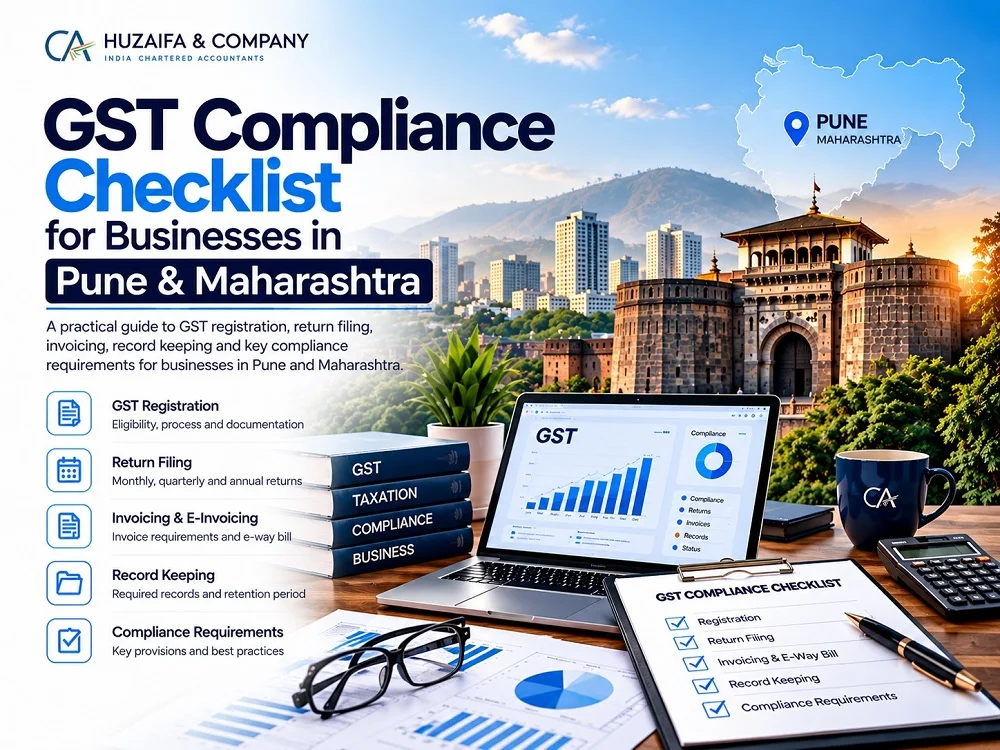
GST compliance is an ongoing responsibility for registered businesses. It involves more than filing a GST return before the due date. Businesses also need to maintain accurate invoices, record outward supplies, review input tax credit, reconcile transaction data and preserve supporting documents.
For businesses operating in Pune and across Maharashtra, a structured GST process can make it easier to manage regular filings, identify mismatches and maintain organised financial records.
Review your GST registration details, invoices, outward supplies, input tax credit, GSTR-1, GSTR-3B, e-invoice and e-way bill requirements, payments and compliance records on a regular basis.
Keep Your GST Registration Details Updated
GST compliance starts with maintaining correct registration information. Businesses should periodically review the details associated with their GST registration and update information where a change requires amendment under the applicable GST rules.
Registration checklist
- Verify the legal name and GSTIN.
- Check the principal place of business.
- Review additional places of business where applicable.
- Check authorised signatory details.
- Review business activity and registration details.
- Keep registration documents and amendments organised.
If your principal or additional place of business is in Maharashtra, ensure the GST registration information accurately reflects the applicable business locations.
Check Every GST Tax Invoice
Accurate invoicing is one of the foundations of GST compliance. Invoice information should be complete, consistent with the underlying transaction and properly recorded in the accounting system.
Invoice checklist
- Correct supplier name, address and GSTIN.
- Correct recipient details and GSTIN where applicable.
- Unique invoice number and invoice date.
- Correct description of goods or services.
- Applicable HSN or SAC information.
- Correct taxable value.
- Correct applicable GST rate and tax amount.
- Correct place-of-supply treatment where applicable.
- Proper treatment of reverse-charge transactions where applicable.
Invoice data flows into GST reporting and can also affect the recipient's input tax credit position. Review invoices before they are included in the relevant return.
Reconcile Outward Supplies Before Filing GSTR-1
GSTR-1 contains details of outward supplies reported by the taxpayer. Businesses should reconcile their sales records with the information being reported before filing.
The GST Portal provides facilities for adding or amending outward-supply records and also allows relevant e-invoice information to flow into GSTR-1.
Before filing GSTR-1, review
- B2B invoices.
- B2C supplies.
- Export supplies where applicable.
- Credit notes and debit notes.
- Amendments to previously reported invoices.
- Applicable HSN-wise outward supply information.
- Taxable value and tax amounts.
- Place-of-supply information.
Review GSTR-3B Before Payment and Filing
GSTR-3B is an important part of regular GST compliance. Businesses should review the figures reported in the return, including outward tax liability and eligible input tax credit, before submitting the return and paying the applicable tax.
GSTR-3B review checklist
- Compare sales with books and GSTR-1 data.
- Review output GST liability.
- Review eligible input tax credit.
- Check reverse-charge liabilities where applicable.
- Review tax payment requirements.
- Check previous-period adjustments where applicable.
- Confirm the return before final filing.
Reconcile Input Tax Credit Before Claiming It
Input tax credit can have a significant effect on the GST payable by a business. However, businesses should not treat every purchase invoice as automatically eligible for ITC.
The applicable GST provisions contain documentary and other conditions for availing input tax credit. Therefore, purchase records, supplier information and relevant GST data should be reviewed before claiming credit.
ITC checklist
- Match purchase invoices with accounting records.
- Verify supplier GST information.
- Review the relevant GST data available for reconciliation.
- Check whether the credit is eligible under applicable rules.
- Identify missing or mismatched invoices.
- Maintain supporting documents.
Perform Regular GST Reconciliation
Reconciliation helps identify differences between books, sales records, purchase records and GST return data. Performing reconciliation regularly is generally easier than trying to identify every difference at the end of the financial year.
Compare sales recorded in the accounting system.
Compare outward-supply information reported on the GST Portal.
Review purchase invoices and accounting records.
Review available GST data against eligible purchase credit.
Check Whether E-Invoicing Applies to Your Business
E-invoicing requirements depend on the applicable rules, taxpayer category and notified turnover or other conditions. Businesses should check the current applicability for their specific circumstances rather than assuming that every GST-registered business follows the same e-invoicing process.
If e-invoicing applies, review
- Invoice data generated from the accounting system.
- IRN generation.
- QR code and invoice details.
- Correct GSTIN and transaction information.
- Cancellation or amendment procedures where applicable.
- Reconciliation of e-invoice data with GSTR-1.
E-invoice thresholds and applicability can change through notifications. Verify the current requirement applicable to your business before relying on a historical threshold.
Review E-Way Bill Requirements
Businesses involved in the movement of goods should review whether an e-way bill is required for the particular transaction and movement.
Under the GST e-way bill rules, a registered person causing movement of goods involving a consignment value exceeding ₹50,000 is generally required to furnish the prescribed information before commencement of movement, subject to the applicable rules and exceptions.
E-Way Bill Checklist
- Correct invoice or document details.
- Correct supplier and recipient information.
- Correct goods and value information.
- Correct transporter information where required.
- Correct vehicle details.
- Validity and movement details.
Track GST Payments and Filing Status
Filing the return is only one part of the compliance process. Businesses should also verify the tax payable, available balances and payment requirements before completing the applicable return process.
Review the GST payable for the relevant period.
Review eligible credit before determining net liability.
Complete applicable tax payment requirements.
Confirm that the return has been successfully filed.
Maintain GST Records and Supporting Documents
A strong GST compliance system depends on maintaining organised supporting documentation. Records should be maintained in a way that allows the business to explain reported transactions and tax positions when required.
Keep your GST records organised
- Sales invoices.
- Purchase invoices.
- Credit and debit notes.
- GST returns and acknowledgements.
- Payment records.
- E-invoice records where applicable.
- E-way bill records where applicable.
- Reconciliation workings.
- GST registration and amendment documents.
- Relevant contracts and supporting documents.
Monthly GST Compliance Checklist
A simple monthly review can help businesses identify errors before they become larger reconciliation or filing issues.
Common GST Compliance Mistakes Businesses Should Avoid
GST errors can arise from incomplete invoices, incorrect reporting, missed reconciliations or weak documentation. A regular review process can help identify these issues earlier.
Filing figures without comparing books, invoices and GST data can increase the risk of mismatches.
Errors in GSTIN, invoice number, tax rate or other required details can create downstream issues.
Input tax credit should be reviewed against the applicable documentary and eligibility requirements.
Businesses should periodically verify whether current e-invoicing requirements apply to them.
Missing invoices, payment records or reconciliation workings can make compliance reviews more difficult.
Keep GST registration details accurate and updated.
Check invoices before reporting transactions.
Reconcile outward supplies before GSTR-1.
Review GSTR-3B liability and eligible ITC.
Review e-invoice and e-way bill applicability.
Maintain organised GST records and reconciliations.
Conclusion: Make GST Compliance a Regular Process
GST compliance is easier to manage when it becomes part of the regular accounting process rather than a task performed only before a return deadline.
Businesses in Pune and across Maharashtra can use a structured checklist to review registration details, invoices, outward supplies, input tax credit, returns, reconciliation, e-invoicing, e-way bills and supporting records.
The exact GST obligations can vary depending on the nature of the business, transaction type, registration status and applicable rules or notifications. Businesses should review their specific position before taking compliance decisions.
Need help with your GST compliance?
Discuss your GST, accounting, taxation or compliance requirements with CA Huzaifa Momin.
DISCUSS YOUR REQUIREMENTSources & Further Reading
GST information in this article is based on official Government of India GST and CBIC resources. Rules, thresholds and procedures can change through notifications.
- GST Portal — Government of India
- GST Portal — GSTR-1 Outward Supplies
- CBIC — GST Tax Invoice Rules
- CBIC — Input Tax Credit Rules
- CBIC — E-Way Bill Rules
- Maharashtra Goods and Services Tax Department